7 Easy Steps to Create a High-Converting Preorder Strategy
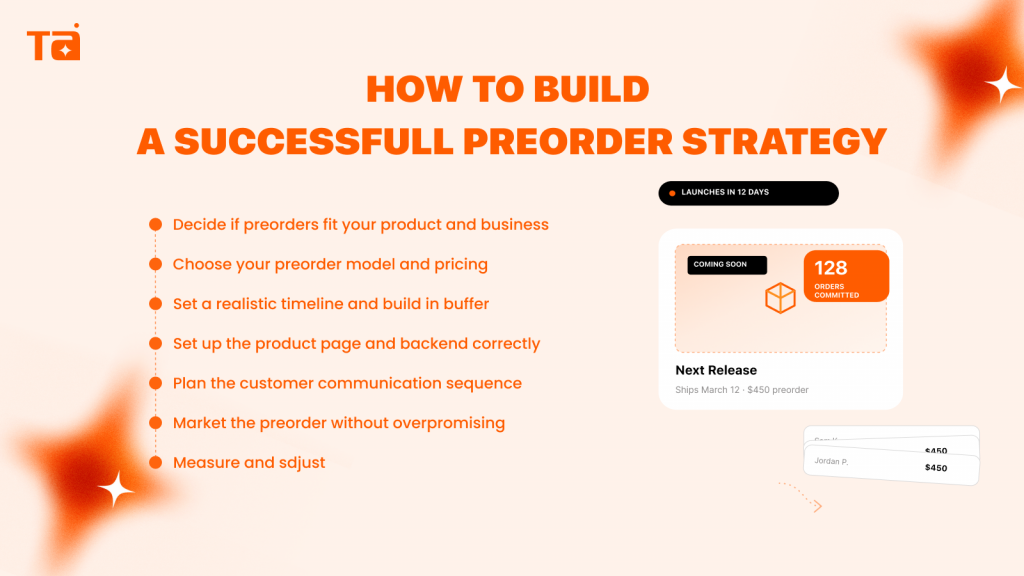
Ask most shoppers what a pre-order is, and they’ll picture a Kickstarter campaign or a video game release. That perception is outdated. A pre-order strategy today is a mainstream retail tool, used by established apparel labels, beauty brands, and consumer electronics companies just as often as by early-stage founders testing an idea.
A pre-order is simply a commitment to buy a product before it’s available to ship. The customer pays (in full, in part, or later) and the brand delivers once stock is ready. What’s changed is the intent behind it. Pre-orders are no longer a workaround for cash-strapped startups — they’re a deliberate way for growing brands to validate demand, manage cash flow, and generate buzz before a single unit leaves the warehouse.
The data backs this up. In an analysis of more than 1 million pre-orders totaling over $85 million in sales, the most consistent theme wasn’t crowdfunding hype — it was operational discipline. Brands that treat pre-orders as a real sales channel, not a stopgap, consistently outperform those that bolt it on as an afterthought.
This guide walks through a complete pre-order strategy: the core principles, what the data says actually works, how to structure payments, how to run the marketing around a launch, and how to avoid the mistakes that turn an exciting launch into a customer service headache.
The 4 Pillars of a High-Converting Pre-Order Campaign
Before getting into tactics, it helps to understand the four things every successful pre-order campaign gets right. Skip one, and the whole campaign gets harder to run.
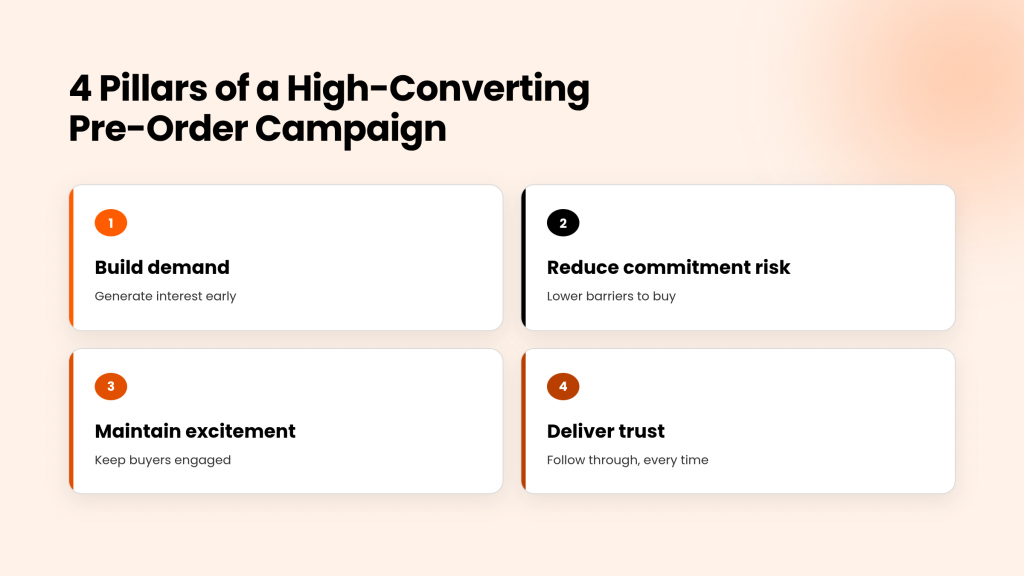
Pillar 1: Build Demand Before You Open Orders
The strongest pre-order launches don’t start on launch day — they start weeks earlier. Teasing a product, sharing behind-the-scenes development, and giving early access to your most engaged customers primes your audience to buy the moment the order window opens. Waiting until launch day to start talking about a product means competing for attention you haven’t earned yet.
Pillar 2: Reduce Commitment Risk
Asking someone to pay for something they won’t receive for weeks or months is a bigger ask than a normal purchase. The most effective campaigns lower that friction with sensible pricing, flexible payment timing, and clear communication about what happens next. This is less about discounting the product and more about reducing uncertainty.
Pillar 3: Maintain Excitement During the Wait
The gap between order and delivery is where campaigns are won or lost. Customers who feel forgotten after checkout are far more likely to request a refund or dispute a charge. Treating the waiting period as an active part of the campaign — not dead air — keeps enthusiasm high until the product ships.
Pillar 4: Deliver Trust Through Fulfillment
The final pillar is often the most neglected: what happens after checkout. Proactive updates, honest timelines, and clear billing communication separate brands that build long-term trust from those that generate one-time buyers and support tickets.
Each of the sections below builds on these four pillars with specific, data-backed tactics.
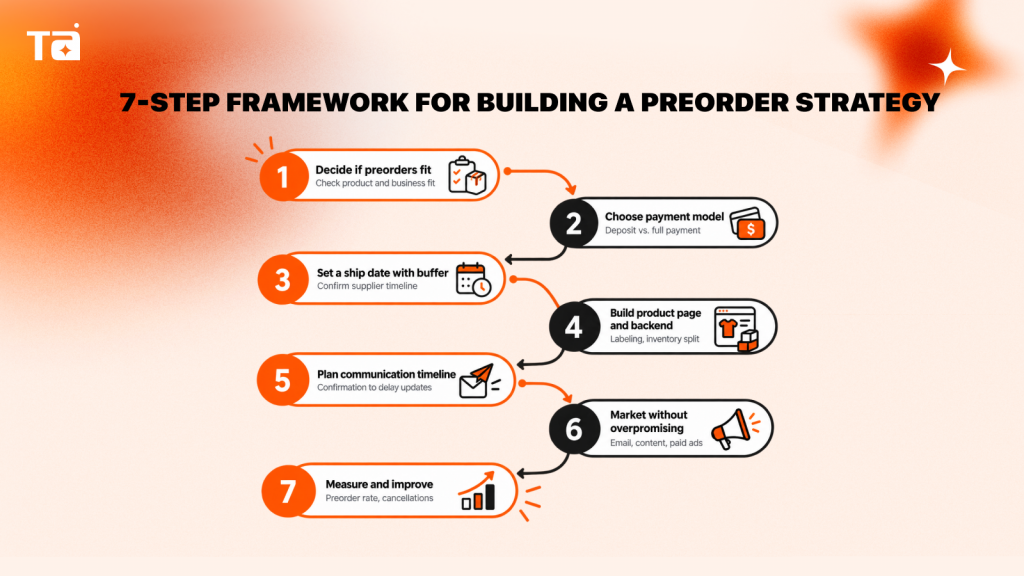
The 7-Step Framework for Building a Preorder Strategy
Each step below builds on the one before it — skipping ahead to marketing before locking in your timeline, or setting up the product page before choosing a payment model, is where most preorder campaigns start to unravel. Work through them in order.
Step 1: Decide If Preorders Fit Your Product and Business
Before touching a product page, answer a harder question: should this product be sold as a preorder at all?
Preorders tend to work well when:
- You’re launching a new or limited product and want to validate demand before committing to full production
- Your product involves custom or higher-cost manufacturing, where funding production upfront meaningfully reduces financial risk
- You have a capital-constrained production run and preorder revenue helps fund the order itself
- The product has genuine scarcity or exclusivity that makes waiting feel worthwhile to the customer
Preorders tend to backfire when:
- The product is a commodity item customers can get elsewhere with immediate shipping
- Your audience has been trained by marketplaces to expect fast delivery, and a multi-week wait feels like a broken promise rather than an exclusive perk
- Your supplier relationship is new or unproven — if they slip, your brand absorbs the damage, not them
- Your margins are thin enough that a meaningful cancellation or refund rate would hurt more than the upfront cash helps
Before committing, run through a short internal check: How confident are you in your supplier’s timeline? Can your business absorb a wave of cancellations if the date slips? Is this product actually differentiated enough that customers will wait, or would they rather buy a similar item in stock right now? If the honest answers are shaky, a preorder campaign will expose that weakness publicly, in front of paying customers.
Step 2: Choose Your Preorder Model and Pricing
Once you’ve confirmed preorders make sense, decide how customers will pay. This decision affects conversion rate, cancellation risk, and how much working capital you actually unlock.
Full payment upfront Customers pay the entire price at checkout. This works best for established brands with existing trust, or for highly anticipated products where demand is already proven. It gives you the most cash certainty, but it’s also the highest-friction option for new or unproven products — asking a stranger to pay in full for something that doesn’t exist yet is a real trust barrier.
Deposit or partial payment Customers pay a portion upfront and the remainder closer to shipping. This lowers the commitment barrier, which tends to increase conversion, especially for higher-priced items. It also softens the blow of cancellations, since customers have less capital tied up if they change their mind.
Discount or incentive pricing Offering early-bird pricing rewards commitment and can accelerate preorder volume, but it also compresses margin during the phase where you may need that revenue most to fund production. Weigh this against your actual cost structure rather than defaulting to a discount because competitors offer one.
There’s no universally correct model — the right choice depends on your price point, how proven the product is, and how much cash flow certainty you actually need versus how much friction you can afford to remove.
Step 3: Set a Realistic Timeline and Build in Buffer
The single most common reason preorder campaigns damage a brand isn’t the concept — it’s a broken ship-date promise. Before you publish anything:
- Confirm the production or supplier timeline directly, not based on an optimistic best-case estimate
- Add a buffer between your internal target date and the date you communicate to customers. If your supplier says six weeks, don’t advertise six weeks.
- Decide your preorder cutoff — the point at which you stop accepting new preorders relative to your expected ship date, so early buyers aren’t stuck behind an ever-growing queue
A date you can hit builds more trust than an aggressive date you might miss. Customers forgive a longer wait far more easily than they forgive a moved goalpost.
Step 4: Set Up the Product Page and Backend Correctly
This is where strategy becomes execution. A few elements matter more than the rest:
Labeling. The product should say “Preorder” clearly, not “Add to Cart” disguised as available stock. Hiding this to boost conversion creates the exact trust problem that turns into refund requests and negative reviews later.
Expected ship date and conditions. State the date plainly, along with anything that could change it. Vague language here creates support tickets later.
Inventory separation. Preorder stock needs to be tracked separately from regular inventory in your backend, so a spike in preorders doesn’t accidentally oversell stock you don’t have or confuse fulfillment for in-stock orders.
Visual proof. If the physical product doesn’t exist yet, your visuals still need to look finished. Product renders, prototype photography, or behind-the-scenes production footage all do more to build confidence than a placeholder image.
Social proof placement. Reviews, early buyer counts, or user-generated content from a prior launch reduce the hesitation of being “first in line” for something unproven.
If you’re running this on Shopify or a similar platform, you’ll typically need a preorder app or a selling plan configured to handle payment timing and inventory separation correctly — the mechanics vary by platform, so confirm how your specific setup handles partial payments and oversell protection before launch.
Step 5: Plan the Customer Communication Sequence
This is the stage most preorder guides skip, and it’s usually where campaigns fail. A preorder is a promise stretched over time, and customers need to hear from you before they start wondering if you’ve disappeared with their money.
A basic sequence looks like:
- Order confirmation — restate the expected ship date and what happens next
- Mid-wait status update — even a short “still on track” message reduces anxiety and support requests
- Pre-ship notice — let customers know shipping is imminent before it happens
- Delay notice, if needed — the message that actually protects your brand when something slips
A good delay message is specific: what changed, what the new date is, and what the customer’s options are (wait, or cancel for a refund). Vague reassurance (“thanks for your patience, more updates soon”) reads as evasive and increases cancellations rather than preventing them.
Pair this with a clear, fair cancellation and refund policy. Offering flexible cancellation isn’t just a support cost — it’s a conversion lever, because it removes the biggest risk a customer is weighing when they decide whether to preorder at all.
One caution worth stating plainly: manufactured urgency — fake countdown timers, fabricated low-stock warnings — damages trust faster than an honest, longer wait does. Customers can tell the difference, and a false sense of scarcity that gets discovered undermines everything else you’ve built.
Step 6: Market the Preorder Without Overpromising
With the operational side in place, marketing a preorder campaign follows a familiar pattern, adapted to the fact that you’re selling something customers can’t hold yet:
- Email sequence to your existing list: a teaser before launch, the launch announcement itself, and a reminder as the preorder cutoff approaches
- Organic content showing real progress: production updates, prototype content, or founder-led explanations of why the product is worth the wait tend to outperform generic stock imagery
- Paid promotion, used carefully: sending paid traffic to a page with a distant ship date typically converts at a lower rate than driving traffic to in-stock products, since cold audiences have less patience for a wait. If you do run paid campaigns, expect and plan for a different cost-per-acquisition benchmark than your usual product pages.
Step 7: Measure and Adjust
Skip vague industry benchmarks you can’t verify for your own store — track your own numbers and use them to calibrate the next launch.
- Preorder rate: preorders divided by total visitors (or total orders during the campaign) tells you how effectively the page and messaging converted interest into commitment
- Cancellation rate: a rising cancellation rate is often the clearest signal that your communication sequence or timeline estimate needs work
- Sell-through speed: how quickly inventory moves once it actually ships tells you whether demand matched your production plan
- Repeat purchase rate from preorder customers: this indicates whether the preorder experience built trust or eroded it
Use these numbers against your own baseline from a prior launch, not a generic percentage pulled from someone else’s campaign — your product, price point, and audience make direct comparisons unreliable.
FAQs
There’s no fixed ideal length — it should match your actual production and shipping timeline plus a reasonable buffer, communicated honestly. A shorter, accurate window builds more trust than a longer one that later needs to be extended.
Send a specific update explaining what changed and the new timeline, and give customers the option to wait or cancel for a refund. Silence or vague reassurance tends to increase cancellations and damage trust more than the delay itself.
It depends on the model you choose. Full-payment preorders charge at checkout; deposit models charge a portion upfront and the balance closer to shipping. Some merchants also charge in full only once the item ships.
Yes, if ship dates aren’t met or communication is unclear. Preorders build trust when timelines are realistic and communication is proactive, and erode it quickly when either of those breaks down.
Conclusion
A pre-order strategy isn’t a workaround for brands that aren’t ready to sell — it’s a legitimate way to validate demand, manage cash flow, and build anticipation before a product ever ships. The data is clear on what separates a strong campaign from a weak one: skip the discount, communicate timelines honestly, choose a payment model that matches your price point and lead time, and keep customers informed from the moment they order to the moment their product arrives.
Brands that treat the pre-order period as an extension of the customer experience — not a black box after checkout — consistently see higher fulfillment rates, fewer cancellations, and stronger repeat purchase behavior. That’s the difference between a pre-order that just generates a sales spike and one that builds lasting trust in the brand.
Don’t let out-of-stock items or upcoming launches mean lost revenue.
Capture every ounce of demand with PreProduct, the smarter way to manage pre-orders and back-in-stock notifications on Shopify.

Hi, I’m Vu Cam Chi – a detail-driven digital marketer focused on building practical growth solutions for ecommerce and digital products. I combine data, user behavior, and clear messaging to turn ideas into results. Strategy guides my decisions, and optimization is part of my daily work. I care deeply about creating experiences that make sense for users and actually perform.