The Most Important E-commerce Trends Shaping 2025: A Competitive Analysis

Starting an ecommerce business is not straightforward, especially when the e-commerce landscape is experiencing a seismic transformation in 2025, driven by technological innovation and evolving consumer expectations. With global retail e-commerce sales projected to surpass $3.6 trillion this year, businesses face unprecedented competitive pressure to adopt emerging trends or risk obsolescence. This comprehensive analysis explores the critical ecommerce trends 2025 that are redefining how brands engage customers, optimize operations, and drive sustainable growth in an increasingly digital marketplace.
AI and Hyper-Personalization Drive Frictionless Experiences
Artificial intelligence has transcended its status as an emerging technology to become an absolute necessity for e-commerce success in 2025. No longer a competitive differentiator but a baseline expectation, AI powers everything from customer service to predictive analytics, fundamentally transforming how businesses understand and serve their customers.

Smarter Chatbots and Virtual Assistants
Advanced natural language processing has elevated AI-driven chatbots beyond simple scripted responses to sophisticated virtual assistants capable of handling complex customer queries. These intelligent systems provide round-the-clock engagement while significantly reducing pressure on traditional call centers. Industry projections indicate that AI will resolve approximately 30% of customer service cases in 2025, delivering faster resolutions and improved satisfaction while allowing human agents to focus on higher-value interactions requiring empathy and nuanced judgment.
The impact extends beyond customer service efficiency. Modern AI chatbots learn from each interaction, continuously improving their understanding of customer intent and expanding their capability to provide accurate, contextual responses. This self-improving nature means that chatbot performance compounds over time, delivering increasing value as the system matures.
AI-Powered Predictive Analytics
Predictive analytics powered by machine learning algorithms enable brands to anticipate customer needs, forecast demand patterns, and proactively prevent churn before it occurs. These sophisticated systems analyze vast datasets including browsing behavior, purchase history, seasonal patterns, and external market signals to generate actionable insights that drive smarter business decisions.
In warehouse operations, AI systems automate restocking decisions by predicting demand fluctuations with remarkable accuracy, minimizing both stockouts and excess inventory. This optimization directly impacts the bottom line by reducing carrying costs while ensuring product availability matches customer demand precisely when needed.
Hyper-Personalization as the New Baseline
Generic, one-size-fits-all shopping experiences have become relics of the past. Modern consumers expect tailored experiences that reflect their individual preferences, shopping habits, and contextual circumstances. Hyper-personalization leverages AI to analyze individual customer data and deliver customized product recommendations, dynamic pricing, personalized content, and individualized marketing messages.
The emergence of agentic commerce represents the next frontier in personalization. In this paradigm, AI systems act autonomously on behalf of customers, anticipating needs and even making purchasing decisions. AI-powered shopping agents can browse products across multiple retailers, compare prices, evaluate reviews, and complete transactions based on predefined customer preferences and budgets. This shift from reactive to proactive commerce fundamentally changes the customer relationship, positioning AI as a trusted advisor rather than merely a recommendation engine.
Leveraging AI-Generated Content
E-commerce brands are accelerating content creation through generative AI, using these tools to rapidly produce detailed product descriptions, tailor marketing copy for specific customer segments, and generate SEO-optimized content at scale. This capability addresses one of the persistent challenges in e-commerce: creating unique, compelling content for thousands or even millions of product listings while maintaining brand voice consistency.
However, successful implementation requires human oversight to ensure accuracy, brand alignment, and the authentic voice that resonates with customers.
The Architectural Shift to Composable Commerce
The monolithic e-commerce platforms that dominated the previous decade are giving way to composable commerce architectures that prioritize flexibility, agility, and best-of-breed functionality. This fundamental architectural shift enables businesses to assemble custom platforms using specialized microservices rather than accepting the limitations of all-in-one solutions. Below is the breakdown of this trend.

Widespread Adoption and Proven Benefits
The composable commerce movement has reached critical mass, with approximately 72% of retailers having explored, implemented, or actively planning to implement composable approaches. This near-universal adoption reflects the compelling value proposition: early adopters report a remarkable 27% improvement in time-to-market and a 25% enhancement in customer experience compared to traditional monolithic platforms.
These performance improvements stem from composable commerce’s fundamental advantage – the ability to select the best specialized solution for each function rather than compromising across all capabilities. Whether choosing a best-in-class search engine, checkout system, or inventory management tool, businesses can optimize each component independently while maintaining system-wide coherence.
Connected Composable Architecture
The evolution from monolithic systems hasn’t meant abandoning structure entirely. The most successful implementations embrace a connected composable approach – building on a well-tested foundational platform while maintaining the flexibility to integrate new microservices seamlessly. This balanced strategy avoids the fragility of completely patchwork systems while preserving the agility that makes composable architecture valuable.
The connected composable model recognizes that not every component needs to be modular. Core infrastructure providing identity management, data orchestration, and security can remain unified while customer-facing features and specialized functions remain independently upgradeable. This pragmatic approach delivers composable benefits without introducing unnecessary complexity.
Headless Commerce Adoption
Headless commerce, which separates the customer-facing frontend from the backend commerce engine, has become a cornerstone of modern e-commerce architecture. This decoupling provides brands with unprecedented creative flexibility, enabling them to design unique user experiences while pushing consistent content and commerce capabilities across websites, mobile applications, IoT devices, and emerging channels.
The headless approach eliminates the constraint of template-based design, allowing developers and designers to create differentiated brand experiences without backend limitations. It also future-proofs commerce infrastructure by enabling brands to adopt new customer touchpoints – from smart speakers to augmented reality interfaces without rebuilding core commerce functionality.
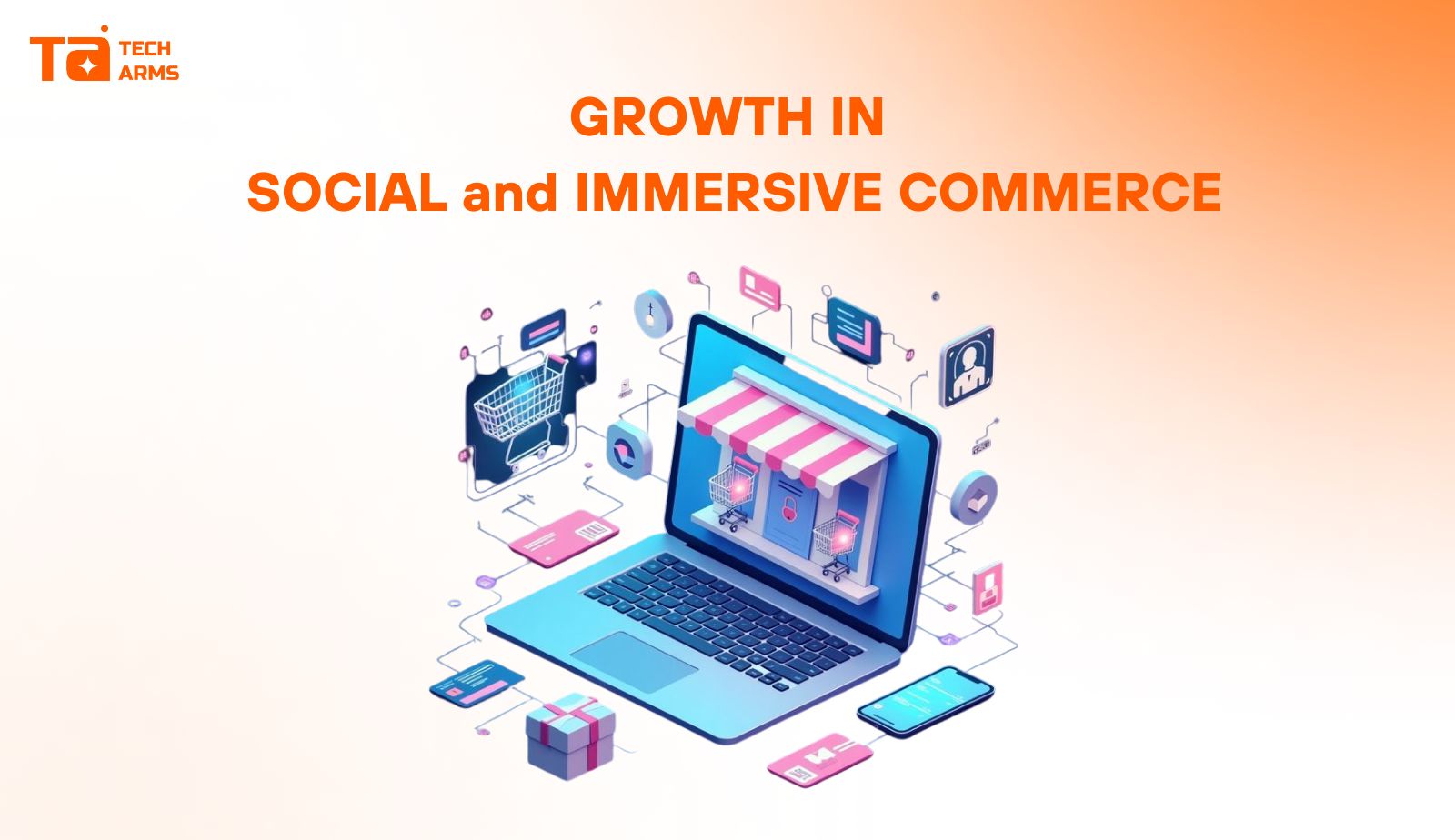
Explosive Growth in Social and Immersive Commerce
The convergence of social media, entertainment, and e-commerce has created entirely new shopping paradigms that blur the boundaries between content consumption and purchasing. Social commerce and immersive technologies are transforming how consumers discover products and make buying decisions, creating unprecedented opportunities for brands that master these channels.
The Rise of Social Commerce
Embedding purchase functionality directly into social platforms represents one of the fastest-growing segments of e-commerce. Social commerce removes friction from the customer journey by eliminating the need to navigate away from social platforms, reducing the steps between product discovery and purchase completion.
Livestream shopping exemplifies this trend’s potential, blending entertainment and commerce in real-time interactive experiences. In the United States alone, livestream sales reached $50 billion in 2023 and are projected to grow to $68 billion by 2026. These live shopping events combine product demonstrations, limited-time offers, and direct audience interaction, creating urgency and engagement that traditional e-commerce cannot replicate.
Influencer Commerce Partnerships
Strategic partnerships with influencers enable brands to reach highly targeted niche audiences with built-in credibility and trust. Unlike traditional advertising, influencer commerce leverages authentic relationships between content creators and their communities, driving direct conversions through shoppable content and live shopping events. The most effective implementations provide influencers with unique discount codes, affiliate arrangements, and co-created products that align with their personal brand.
Immersive Technologies Enhance Discovery
Augmented Reality and Virtual Reality technologies have transitioned from experimental novelties to practical tools that meaningfully improve the shopping experience. AR applications allow customers to visualize furniture in their actual living spaces, try on clothing and accessories virtually, or see how paint colors would appear on their walls. These capabilities address one of e-commerce’s persistent challenges – reducing the uncertainty that comes from purchasing products sight unseen.
Voice Search Revolution
Voice-activated shopping through smart speakers and digital assistants represents a fundamental shift in how consumers search for and order products. Voice search optimization requires a different approach than traditional SEO, emphasizing conversational language patterns, question-based queries, and long-tail keywords that match natural speech patterns. With this strategy, brands must adapt their content strategy to address how people actually speak rather than type, focusing on answering common questions clearly and concisely.
Mobile Optimization and Flexible Payment Ecosystems
Mobile commerce continues its relentless growth trajectory, fundamentally reshaping how consumers interact with brands and complete purchases. The smartphone has become the primary shopping device for a growing majority of consumers, making mobile optimization not optional but essential for e-commerce success.

Mobile Shopping Dominance
Mobile commerce generated an impressive 69% of online shopping orders worldwide in the second quarter of 2025, underscoring the absolute necessity of mobile-first design. Projections indicate mobile will account for over 60% of all e-commerce sales by 2027, cementing its position as the dominant channel for online shopping.
Successful mobile commerce requires more than responsive design – it demands streamlined navigation optimized for touch interfaces, fast-loading pages that accommodate variable connection speeds, and friction-free checkout processes. Mobile wallets enabling one-click checkout have become table stakes, reducing cart abandonment by eliminating the tedious process of entering payment and shipping information on small screens.
Digital Wallets Dominate Payment Landscape
Worldwide, by 2030, digital payments are projected to grow beyond $33.5 trillion, surpassing traditional credit and debit cards as the preferred payment method. This dramatic shift reflects consumers’ preference for payment solutions that combine convenience, speed, and security. Digital wallets utilize tokenization and biometric verification to provide secure transactions while dramatically reducing checkout friction.
The dominance of digital wallets varies by region, with certain markets showing even higher adoption rates. If using this method, retailers must support a diverse portfolio of wallet options including Apple Pay, Google Pay, PayPal, and region-specific solutions to meet customer expectations and avoid unnecessarily limiting their addressable market.
Buy Now, Pay Later Expansion
Buy Now, Pay Later arrangements have gained significant traction across global markets, appealing particularly to younger consumers seeking budget flexibility without traditional credit cards. BNPL services split purchases into interest-free installments, reducing the psychological barrier of large upfront costs while helping customers manage their budgets more effectively.
For retailers, BNPL options frequently lead to increased average order values as customers feel more comfortable making larger purchases when payment is distributed over time. However, responsible implementation requires clear communication about payment terms and potential fees to maintain consumer trust and comply with evolving regulations governing BNPL services.
Sustainability, Ethics, and Loyalty as Core Differentiators
Environmental consciousness has evolved from a niche concern to a mainstream expectation that fundamentally influences purchasing decisions. Sustainability is no longer merely a marketing talking point but a core business imperative driven by both consumer demand and increasing legislative requirements.
Sustainability as a Loyalty Driver
Consumers worldwide increasingly favor brands that align with their environmental values, positioning sustainability as a cornerstone of customer loyalty. Many consumers demonstrate willingness to pay premium prices for sustainable products, whether locally sourced goods, items made from recycled materials, or products from companies with transparent environmental commitments.
Kim Hardaker, Sustainability Advisor at Global Loyalty Organisation, notes that environmental alignment has become essential: consumers are scrutinizing supply chains, packaging choices, and corporate environmental policies with unprecedented attention. Brands that authentically embrace sustainability, rather than merely engaging in greenwashing – build deeper, more resilient customer relationships.
Transparency and Ethical Sourcing
Businesses must actively highlight ethical sourcing practices, supply chain transparency, and efforts to reduce wasteful packaging. Blockchain technology offers promising applications for supply chain transparency, enabling customers to trace products from origin to doorstep while verifying authenticity and ethical production claims. This level of transparency builds trust and differentiates brands in increasingly crowded markets.
Balancing Personalization with Privacy
Regulations including GDPR in Europe and CCPA in California have established strict requirements for data collection, usage, and consumer rights. E-commerce businesses must navigate the delicate balance between leveraging customer data for hyper-personalization and respecting privacy rights and regulatory compliance. Building trust through transparent data practices and giving customers meaningful control over their information has become essential for maintaining positive customer relationships.
Emerging Market Shifts and Vertical Innovations
Beyond the headline trends, several significant market shifts and vertical-specific innovations are reshaping the e-commerce landscape in 2025, creating new opportunities for growth and competitive differentiation. Let’s explore in details.

B2B E-commerce Adopts B2C Standards
Business-to-business buyers increasingly expect the same sophisticated, user-friendly experiences in their professional purchasing that they encounter as consumers. The line between B2B and B2C e-commerce is blurring as procurement professionals demand speed, convenience, and personalization in their work lives matching what they experience shopping online personally.
Progressive B2B companies are developing customer-friendly webshops and self-service portals offering personalized pricing, custom catalogs based on customer segments or contract terms, and streamlined reordering processes. The global business-to-business e-commerce market is expected to grow at a compound annual growth rate of 14.5% through 2026, reflecting the massive opportunity in digitalizing B2B commerce.
Blockchain for Security and Transparency
Blockchain technology extends beyond cryptocurrency to offer practical applications in e-commerce. By creating immutable transaction records, blockchain enhances security, prevents fraud, and enables end-to-end product traceability. Consumers can verify product authenticity, confirm ethical sourcing claims, and trace items through complex supply chains. Additionally, blockchain provides enhanced protection for personal data through decentralized storage and cryptographic security.
Conclusion
The e-commerce trends 2025 outlined in this analysis only represent fundamental shifts in how online retail operates, not temporary fads destined to fade. Success in this evolving landscape demands both technological sophistication and unwavering consumer-first thinking.
Looking toward 2026, the most successful retailers won’t just adopt new trends – they will weave them into a single, cohesive digital strategy. The real magic happens at the intersections: where AI-driven personalization meets the convenience of mobile shopping, and where flexible, composable architecture allows brands to pivot instantly into social commerce. By grounding these innovations in a commitment to sustainability, you can build the deep-seated trust required for meaningful customer relationships. We hope these insights give you the roadmap you need to lead the market and scale your business.


Hi, I’m Vu Cam Chi – a detail-driven digital marketer focused on building practical growth solutions for ecommerce and digital products. I combine data, user behavior, and clear messaging to turn ideas into results. Strategy guides my decisions, and optimization is part of my daily work. I care deeply about creating experiences that make sense for users and actually perform.