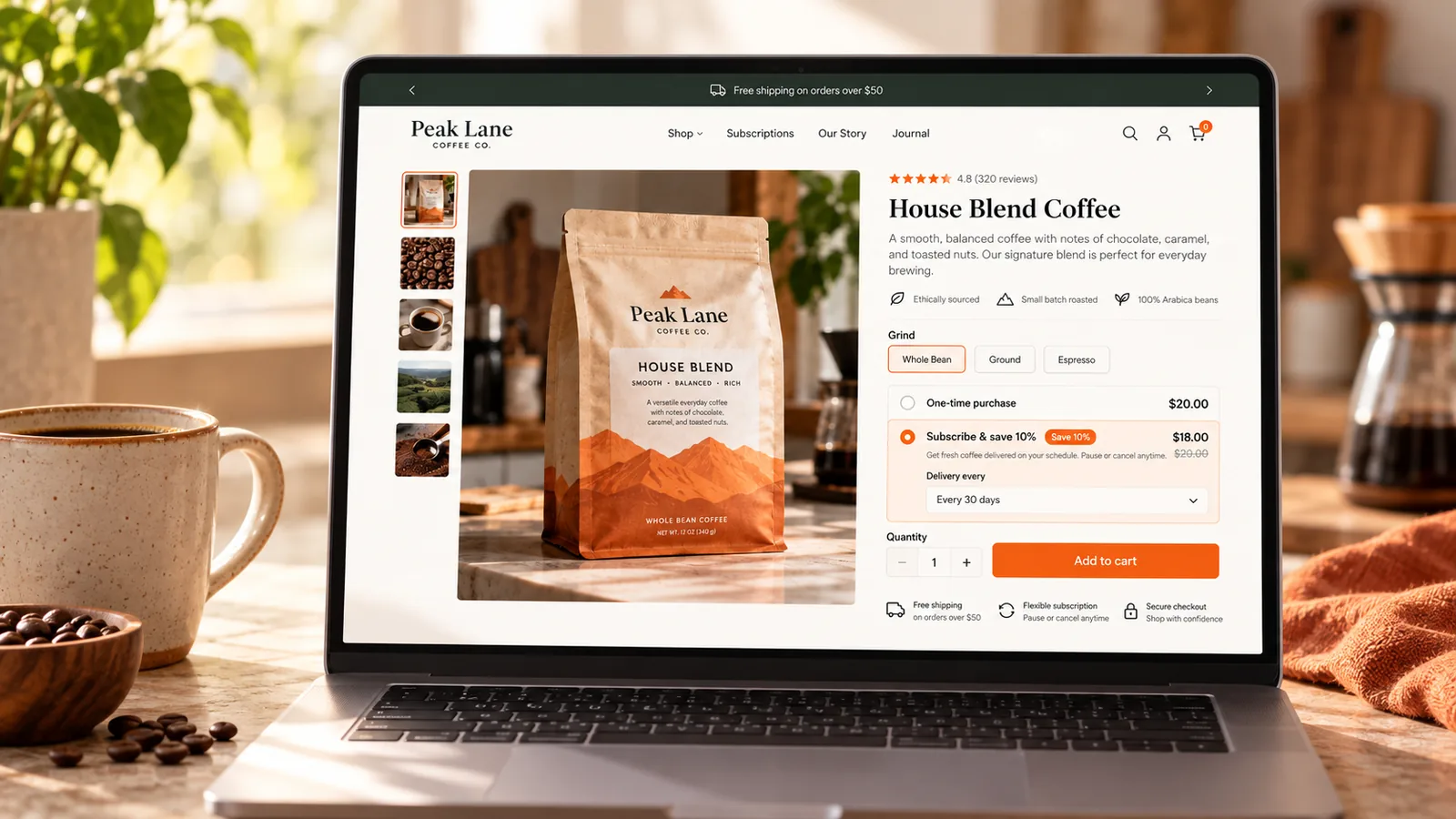

Subscriptions aren’t a niche trend anymore, they’re how a huge share of online shopping happens. Roughly 8 in 10 adults now pay for at least one subscription service, and the global subscription ecommerce market is projected to reach USD 2,419.69 billion by 2028. At the same time, overall retail sales are expected to grow 4.9% in 2024, hitting $31.1 trillion worldwide.
If you’re a merchant weighing whether to add recurring billing to your store, the real question isn’t “should I launch a subscription program?” It’s “which ecommerce subscription model actually fits my product?” Picking the wrong one is one of the most common reasons subscription launches fail to gain traction.
This guide breaks down the three primary ecommerce subscription models, five hybrid and alternative variations, the benefits driving brands to adopt them, real case studies, and a step-by-step plan to launch your own.
What Are Ecommerce Subscriptions?
An ecommerce subscription model is a purchasing structure where customers pay on a recurring schedule — weekly, monthly, or quarterly — to automatically receive products or services, instead of buying once and walking away.

The bigger shift here is in the relationship itself. Traditional ecommerce is a one-off checkout: the customer decides, pays, and the transaction ends. A subscription model turns that single decision into an ongoing relationship — the customer consents once, and value keeps flowing afterward. That’s a fundamentally different growth lever for a brand, because it converts a single sale into months (or years) of predictable revenue.
It’s also worth noting how big the shift toward mobile has become inside this picture. By 2024, mobile sales are expected to account for 70% of retail ecommerce, which means any subscription program needs to work flawlessly on a phone, not just a desktop checkout page.
The 8 Primary Ecommerce Subscription Models
Most subscription programs you’ll encounter online fall into one of three core buckets. Understanding these first will make every hybrid model later in this guide much easier to evaluate.
1. Replenishment
This model auto-ships essential, frequently used items before the customer runs out — think groceries, pet food, vitamins, or razors. It works because it removes a recurring chore (reordering) and usually comes with a discount as an incentive to commit.
Best for: Commodity products with predictable depletion rates — anything customers buy on a routine cycle.
2. Curation
Curation subscriptions deliver a rotating, personalized selection of products based on a theme or the customer’s stated preferences. Beauty boxes, snack boxes, and book subscriptions are classic examples.
Key driver: The surprise and delight factor. Customers aren’t just buying a product — they’re buying discovery, and the anticipation of opening the box.
3. Access
Here, a recurring fee unlocks members-only perks, discounts, or premium content rather than a specific physical product. Amazon Prime and Netflix are the most recognizable examples.
Key driver: Loyalty and exclusivity. Customers stay subscribed for the ongoing value of membership, not for a single delivered item.
4. Hybrid Model
A hybrid model combines elements of more than one core type — for example, a replenishment service that also grants access to member-only digital content or community perks. This is increasingly common as brands look for ways to deepen loyalty beyond just the physical product.
5. Fixed / Flat-Rate Pricing
This model charges a preset price for a predetermined set of products or features over a fixed time period. It’s especially common in SaaS, but plenty of product-based ecommerce subscriptions use flat-rate tiers too, since it makes billing simple and predictable for both sides.
6. Pay-As-You-Go (PAYG)
A usage-based model where customers only pay for what they actually consume — cloud storage and telecom plans are the most familiar examples. It’s less common in physical product subscriptions but worth knowing if your offering scales with usage.
7. Build Your Own Box (DIY)
This model gives customers full control to select the specific products, quantities, and pricing for their own recurring delivery. It sacrifices some of the “surprise” of curation in exchange for higher customer satisfaction and lower return/cancellation rates, since shoppers get exactly what they want.
8. Unlimited Subscription
A set monthly or annual fee grants unrestricted access to a product or content library — digital newspaper access is a common example. This model thrives when the marginal cost of serving an additional unit (an article, a stream, a download) is close to zero.
Why Brands Are Switching to Subscription Models
The growth of ecommerce subscription models isn’t just a customer-side trend — it’s being driven by clear operational benefits on both ends of the transaction.
For retailers:
- Predictable revenue. Recurring billing stabilizes cash flow and makes revenue forecasting far more reliable than relying on one-off purchases.
- Inventory optimization. Knowing how many subscribers you have lets you forecast demand more accurately, which simplifies stock management and supply chain planning.
- Higher lifetime value. Subscriptions consistently boost customer lifetime value (LTV) and retention rates compared to one-time sales, since each customer represents months of future revenue instead of a single transaction.
For consumers:
- Convenience. No more remembering to reorder — the product just shows up.
- Cost savings. Subscribers often get exclusive discounts or bulk pricing unavailable to one-time buyers.
- Personalization. Curated and tailored experiences make customers feel understood, which builds an emotional connection to the brand beyond the product itself.
Successful Subscription Implementations
Seeing these models in action makes it much easier to figure out which one fits your own catalog.
Replenishment: Pet Circle. This pet supply retailer found strong traction by offering an auto-delivery option for heavy, frequently-needed items like pet food bags — a natural fit for the replenishment model. To entice shoppers to switch from one-time purchases, they offered a 10% discount on subscribed orders, directly addressing the friction of carrying heavy bags home from a store.
Curation: Bluum. Bluum targets busy working parents with a monthly box of infant products. The model works because it solves a real time-constraint problem: new parents often don’t have the bandwidth to research and compare baby products themselves, so curation does that work for them.
Discovery: Birchbox. Birchbox built its model around samples, letting customers try new beauty products in smaller formats before committing to a full-sized purchase. This lowers the risk of trying something new and turns the subscription itself into a discovery engine for the brand’s broader catalog.
Learn how to build a subscription box in 6 steps
FAQs
Consumables tend to perform best — think coffee, vitamins, pet food, and personal care items that customers naturally reorder on a predictable cycle.
Yes — recurring revenue lowers the long-term cost of customer acquisition, since you’re not having to win the same customer’s business over and over with every single order.
Conclusion
Choosing the right ecommerce subscription model comes down to understanding your product and your customer’s real motivation for subscribing. Replenishment works because it removes a chore. Curation works because it delivers discovery. Access works because it sells exclusivity. And the hybrid and alternative models — flat-rate, pay-as-you-go, DIY boxes, and unlimited access — give you room to combine these motivations as your offering matures.
Whichever model you choose, the brands seeing the most success are the ones who match the model to the product, keep the experience simple on mobile, and make cancellation genuinely easy rather than treating it as a retention trap.
Ready to Scale Your Recurring Revenue?
Don’t get bogged down by complex billing or rigid systems. Install the Subi Subscriptions app on Shopify today to launch and scale your membership or subscribe-and-save program in days, not months.